|
Reel Paradise - Synopsis
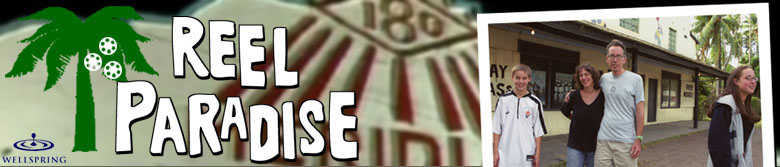
Reel Paradise tells the story of John Pierson's family at the end of a year-long adventure on a
remote island in Fiji where they ran the 180 Meridian Cinema, showing free movies to the locals.
John Pierson is a noted indie film maven, author of the widely celebrated book, Spike, Mike,
Slackers & Dykes, who together with his wife Janet created the IFC cable show Split Screen.
On one story for the show, John and family went to Fiji in search of the "world's most remote
movie theater."
John fell in love with the 180 Meridian Cinema when he saw the wild enthusiasm of the audience to
a showing of the Three Stooges' Some More of Samoa - a short they had been showing at the theater since it opened in 1954. "I'd never remotely heard anything like that," John says in Reel Paradise. "This is somehow what I missed back when movies meant everything to people."
John decided he wanted to move with his family to Fiji and observe what movies meant to this country on the other side of the world. He also saw this adventure as an opportunity to plunge his two kids, Georgia (16) and Wyatt (13), into a culture and lifestyle far different from that of their home outside New York City.
Filmed during the last month of the family's yearlong stay in Fiji, Reel Paradise aims to reveal something of what the whole year has been like for the Piersons. The rural island of Taveuni is not one of Fiji's prime tourist destinations. Like most of the south Pacific islands, its people struggle to eke out a subsistence living as farmers, fisherman, and merchants. To the local Fijians, the Piersons are thought to be millionaires, because they are able to live in a large colonial home and show movies for free. (The home is indeed impressive by Fijian standards, though barely acceptable by middle-class western standards.)
Georgia and Wyatt are enrolled in the local Catholic high school, where they are the only white students. They gamely throw themselves into this very different school environment where some view them as curiosities, and others as suspicious outsiders. The kids form friendships with some classmates, many of whom live in the nearby village of Natokalau but come to treat the Pierson house as a second home. Janet follows their lead, befriending some of the families in the village.
John's village, says Janet, is the movie theater. John carries on the theater's tradition of showing a wide range of American, British and Hindi films. (The Fijian population is split between native Fijian islanders and Indo-Fijians whose ancestors immigrated here as indentured servants starting in the 1880s.) The profound difference now is John's ability to show the movies for free due to contributions from indie filmmakers he had helped in the past. For many in Taveuni, going to movies had been impossibly expensive before the Piersons arrived. Now, the 180 Meridian Cinema becomes the focal point of entertainment on the island with frequent packed houses. John is able to secure many of the most current popular and blockbuster releases from America and abroad, everything from Rabbit Proof Fence and Bend it Like Beckham, to The Scorpion King and The Hot Chick. For their last month in Fiji, John programs a special ten-day movie marathon featuring films like Matrix Reloaded, Bringing Down the House, Apocalypse Now Redux, and Jackass.
Because the Piersons are neither tourists nor permanent residents of Taveuni, their year here proves to be a complicated experience. They form strong friendships with locals like their cook Sia, and come to understand how third world islanders cope with day-to-day life. But they also experience culture clash and learn firsthand the realities of being "haves" in a culture of "have-nots." Early in the film their home is robbed while they are out showing a movie. It's the second such serious robbery since they've been in Fiji, and raises anew questions about whom they can trust or not trust. Their paranoia extends to their landlord Andrew, an Australian ex-patriot who lives on the property and has been a yearlong thorn in the side of the Pierson family. When Andrew insensitively presents the Pierson's with a fuel bill the night of the second robbery, its strikes another blow against the notion that living here can be some kind of paradise.
As Reel Paradise unfolds, we see the differing ways in which each of the Piersons deals with living in this very different culture. Showing movies for free makes John instantly famous as "Uncle John" to the locals - especially those that could never afford to go to the movies otherwise. Yet, the free movies also bring John into direct conflict with some of the local Catholic priests, a battle he humorously characterizes as being for the "souls of the people of Taveuni." Wyatt becomes a star pupil at school, praised repeatedly by teachers and administrators. Because the curriculum is not challenging for her, Georgia struggles with some of her teachers while forming a deep friendship with a local classmate named Miriama. School may be a bust for her, but she clearly loves Fijian life.
The Piersons grant the filmmakers unusually intimate access to the family's home life. The result is a frank portrait of a very American family abroad. We see the struggles between Georgia and her parents around typical issues for American 16 year-olds, now exacerbated by living in a culture in which children are never expected to talk back to parents. Yet, Georgia's friend Miriama prefers to stay with the Piersons instead of her own family where the father has been violent towards her and her mother. We also see that though Wyatt may be the quiet obedient student at school, he can be a tough and ruthlessly funny critic of his father and mother at home. Through it all, we see Janet playing the role of peacekeeper, the voice of reason during a particularly tumultuous last month abroad.
By the end of the film, we see how the Piersons have both been changed and unchanged by their experience. As unusually candid subjects, the family does not sugarcoat their feelings towards each other or their experience in Fiji. But underneath it all, there is no mistaking their affection for both. The last movie in the ten-day marathon (and last scene in the film) captures the essence of what John went searching for in Fiji. He shows Buster Keaton's classic, Steamboat Bill Jr., in part because he thought its climatic hurricane sequence would connect with the Fijians who had suffered through a devastating hurricane months earlier. The audience's howls of laughter betray the sweet release that great comedy can bring to hard lives. John says, "You almost feel like it's a cure for all that ails you. It was like nothing else matters anymore. All will be right with the world."
|
 |

 |

I'm seated, with my mother, on a palace veranda, cooled by a breeze from the royal garden. Before us, on a dais, is an empty throne, its arms and legs embossed with polished brass, the back and seat covered in black-and-gold silk. In front of the steps to the dais, there are two columns of people, mostly men, facing one another, seated on carved wooden stools, the cloths they wear wrapped around their chests, leaving their shoulders bare.
Read More...
|

Then there's Hollywood's interpretation of the island...
To see that, check out Reel Paradise, a movie about the saga of American film maker maker John Pierson who in 2002 relocated his family
to Taveuni for a year to show free movies at the venerable Meridian Cinema near Waiyevo.
Read More...
|

Interview with John and Janet Pierson - Reel Paradise
On the latest episode of DVD Talk Radio, DVD Talk Editor Geoffrey Kleinman speaks with John and Janet Pierson about the DVD release for Reel Paradise.
Read More...
|

No Family Is an Island
BY SPENCER PARSONS
The Piersons on 'Reel Paradise'
Read More...
|
|
Reel Paradise: Review
BY Marc Savlov
When it comes to mid-life crises, some guys buy Porsches, some nail hot blondes,
and some just muddle through. Freshly minted Austinite and famed producer's rep/author/gadabout John Pierson chose to relocate his entire family.
Read More...
|

'Reel Paradise': Moving Theater Experience in Fiji
by Alex Chadwick
American movie buff and independent filmmaker John Pierson moved his family to Fiji in 2002 in search of "the world's most remote theater."
Read More...
|

Reel Paradise: Review
By Roger Ebert
Steve James' new documentary, "Reel Paradise," is about a couple with similar idealism, who also move to a small town and buy the movie theater.
Read More...
|

Reel Paradise: Review
By Kevin Crust
MOVIE REVIEW: A family, a film house and Fiji.
Read More...
|
|
Taking popcorn fare to paradise
By Merrill Balassone
It's like moviegoing is new again when a producer shows free films in Fiji.
Read More...
|

How an American family moved to Fiji and brought Hollywood along for the ride
By Edward Guthmann
After 25 years of making top-notch indie films, John Pierson needed to escape. So off to Fiji he went, bringing
his family to begin a new life. He documented the experience in "Reel Paradise."
Read More...
|

Keeping It 'Reel' in Paradise
By ANDY KLEIN
In 2002, well known indie film figure John Pierson - producer's rep for She's Gotta Have It, Clerks, and Roger & Me, host of IFC's Split Screen series, and author of Spike, Mike, Slackers
& Dykes - picked up his family and moved to Fiji for a year to show free movies.
Read More...
|

LA Weekly: Film
By Scott Foundas
The final month of Pierson's quixotic quest is chronicled by documentary filmmaker Steve James in Reel Paradise and the result is an enormously warm, comic travelogue about how you can go to the ends of the earth and still not escape from temperamental
teenagers, absentee landlords and the universal language of moving pictures.
Read More...
|

Creating a Free Cinema Off Beaten Track in Fiji
By STEPHEN HOLDEN
Steve James's absorbing documentary follows a family to the rural Fijian island of Taveuni, where they showed free
movies in the world's most remote movie theater.
Read More...
|

'Paradise' found in Fiji
By LILY OEI
Indiewood came out in droves Monday to celebrate the Gotham preem of Wellspring's "Reel Paradise."
Read More...
|
|
A Cinema So Indie It's 5,000 Miles Away
By David Hochman
The Pierson's experiences running a cinema in Fiji are the subject of the documentary "Reel Paradise."
Read More...
|

On Screen and In a New City, Austin Embraces The Pierson Family
By Eugene Hernandez
These days, aside from traveling to a few film festivals to talk about Steve James' Miramax doc about their time in Fiji, "Reel Paradise,"
the Pierson's have become key figures within the Austin film scene.
Read More...
|
|
Variety - Reel Paradise
By Todd McCarthy
Indie film guru John Pierson goes native, sort of, in "Reel Paradise," an engaging docu about his year-long
stint showing free movies to the locals at what's purportedly
the world's most remote cinema, the 180 Meridian in Taveuni, Fiji.
Read More...
|
|
Sundance #3: Of heart and humor
By Roger Ebert
Another Sundance doc is also a wonderful portrait of an unexpected lifetime. Steve James, who directed
"Hoop Dreams," is here with "Reel Paradise," the story of a New Yorker named John Pierson, who distributed
and represented the films of Spike Lee, Kevin Smith and many other indie directors,
and hosted "Split Screen," an IFC program on independent films.
Read More...
|

Paradise Found
By Bill Chambers
Hoop-dream master Steve James on his latest film, REEL PARADISE
Read More...
|
Isle of Forgotten Fans
By John Pierson
I recently became the proud owner of the world's most remote movie theater. A year from now, you could be wearing a T-shirt that says, "I saw it at the 180 Meridian Cinema." At least that's how I see it.
Read More...
|
Fiji Favorites: Guys in Dresses
By Dave Kehr
The Piersons are back, and the New York independent film community is happy to see them home.
Read More...
|
 |


|

|

|
|
|