|
PIERSON FAMILY Q&A
How'd you get your films?
JOHN: Mostly we showed what we thought were the best, or most likely to succeed, titles that were
already in Fiji and approved by the Censor Board. The only way to import prints would've been
through the US Embassy, and they weren't interested
What were the audiences' favorites?
JOHN: SCORPION KING. Anything with J.Lo. BEND IT LIKE BECKHAM.
GEORGIA: They laughed their asses off at guys in drag, like in THE HOT CHICK or SORORITY BOYS.
WYATT: But sometimes Dad would show a movie that only he liked, and that didn't work.
Like APOCALYPSE NOW REDUX. People were sleeping. I always said it should've been "reduxed" by 90 minutes.
GEORGIA: Dad talks about how RABBIT PROOF FENCE did well. We think maybe it was because there was a bunch of walking in it. People in Fiji walk everywhere, so they could relate.
What's going on with the cinema now?
JOHN: Still closed. When I call Taveuni, the people wish the movies were playing. The kids went back alone last year.
WYATT: We saw some sort of religious services inside.
JOHN: That's poetic justice. I've offered my fat set of keys to festival audiences starting at Sundance, and I've had about six takers. But that place is not easy to operate, not to mention the fact that the lease for the land under the cinema is in dispute.
What are the kids doing now?
WYATT: I'm in public high school in Austin, TX starting 10th grade, which is the equivalent grade I was in at Holy Cross in Fiji two years ago.
GEORGIA: I graduated from high school, my seventh, in Austin. I've been working at Landmark's Dobie Theater since Christmas, and I just started culinary school at the Culinary Academy of Austin.
How'd you feel about allowing yourself to be filmed?
JANET: I know the film has me saying NO at the outset, but the rest of the sentence was that I took a deep breath, thought of all the documentary films that have meant so much to me over the last 30+ years, like HOOP DREAMS, the films of Rob Epstein, SOUTHERN COMFORTÐ films where the subjects really had something to lose and I knew I had to allow ourselves to be part of it. No one's more honest and open than we are Ð I knew that could be really useful. And I also understood what a really good story it was.
WYATT: I didn't think anyone was going to watch it, so I really didn't care.
JOHN: What was important to me was sharing the experience of seeing movies at the 180. It was magical. I thought having dengue during filming was pretty awful, but it's not really a big deal in the film.
You know so many documentary filmmakers, why Steve James?
JOHN: Steve was always on the top of our short list. And Chris Smith too. Good directors, standup human beings.
JANET: Besides loving Steve's work, it was important to me how much he appreciates being married and loves his own kids. I believed he's a filmmaker that's sensitive to all his subjects, not at all condescending. And it meant a great deal too that PH O'Brien, our longtime friend and Split Screen collaborator was going to shoot the film. He'd been with us on our initial trip for Split Screen in Feb. 2000. Then he came over and spent a month before the shoot just hanging out and experiencing Fijian life.
What was it like being filmed?
JANET: Ironically in 24 hours I went from "I'm not comfortable being filmed" to "they're not filming me!" There was one camera, and four principals, not to mention the Fijians. There was only so much the camera could cover. And what's surprising too, is that people always assume the cameras are intrusive, when actually there was this instinct to share our experience with them. You know, like "Can you believe this? Check that out!"
GEORGIA: More than how we changed, I think it changed how the Fijians acted. They'd kind of stay away, and they wouldn't speak English to the camera. Everything happened, but I think things would have happened differently if the camera hadn't been there.
Was it hard coming back?
JANET: No. Electricity's pretty easy to get used to.
WYATT: I think now I see things more openly. Or at least I notice more how close-minded other people are.
GEORGIA: It's a lot colder and less friendly here. Everyone you see in Fiji smiles and says hi to you. Hitchhiking is a major method of transportation. You could really live for free there. People feed you, everyone shares everything, and you can fall asleep in the middle of a field and no one messes with you. You can't really do that here very easily.
How were you changed by this?
WYATT: My sister and I get along much better now. We weren't close before, but in Fiji there was no one else who really spoke English and who could understand all the funny things.
JANET: I think we're all less materialistic. We buy less. And I know we're a stronger family because of both living in Fiji and making the film. We understand now what it's like to be documentary subjects. The kids have been very thoughtful and smart and understanding about this whole process.
JOHN: Instead of having a family fight, now we can all gang up on Steve instead.
Has Georgia been in touch with Miriama?
GEORGIA: When Wyatt and I went back last year we saw everyone. She's still in the same grade turning in my work from the previous year -- doing very well I might add. I got one letter from Miriama but it's hard to stay in touch. 70 cents for postage there is as hard to come by as the motivation to write a letter here.
From your perspective now, would you have done anything differently?
JANET: I would have hired someone to act as security in the house the minute the film crew arrived. I'd meant to, and just got distracted. Avoiding that robbery could have really changed the last month. I'd expected a lovely sentimental leave-taking, instead I was counting the minutes to get off the island without more mishaps.
GEORGIA: Absolutely. I probably would have avoided the camera even more, it only attracted drama.
Have the Fijians seen the film?
WYATT: No, they'd hate it. They might like seeing themselves at first, but there's too much talking.
JANET: We had two Fijians at the first screening in Sundance. One is Keni Madden
who's in the film. The other is Dan Bolea, the head of the Fiji Audio Visual Commission.
Dan felt it was a very honest portrait. Then we had more Fijians in the screenings in Salt
Lake City - there's a community of Fijians who've become Mormons there - they totally embraced it. But in Fiji itself, it would probably be a different story because of the language.
Did you learn the language?
WYATT: No, it was too hard.
GEORGIA: I understood a lot but always responded in English.
JOHN: Let me interject here - English is the language of education. There has never been a movie made in Fijian, dubbed in Fijian, or subtitled in Fijian. English, or Hindi, is the language of the movies.
Did you have any say in the editing?
JOHN: Steve worked by himself until he had a rough cut of about 2 1/2 hours. Then he showed it to us. The first day, maybe week, was traumatic. I think we went at it hot & heavy for about a month until a test screening with an audience of 100 helped everyone focus on the film's strengths and weaknesses. Georgia & I really took some heat that night.
GEORGIA: Editing makes everything look a lot more extreme. There's always the question of why I'm a bastard that comes up in terms of the family seeming dysfunctional. The stuff they put in the movie does make me seem like an asshole. And I did it, and I'd probably do it again. But it's completely out of context. Maybe there's stuff that I did that could have been shown that if you saw it I'd redeem myself a little more, you know? I can't deny that anything happened but people need to understand characters are developed to fit the flow of the movie.
Any audience friction so far?
JOHN: Not so much in 14 festivals, except...
GEORGIA: When we went to Portland that was the coolest thing ever. At Sundance everything was smooth, everyone was nice, and things were natural and we could kind of just giggle about everything. But at Portland, there were these crazy, righteous people that just hated it. They'd stand up and give a long speech about how we should have taken sensitivity training before we went or something. They were like, "Boo to you guys for ruining the world!" And we were just going to live there for a year, and most of the stuff we showed had already made it there on bootlegs. We weren't forcing people to come to the movies. We were just making them available. We were easily avoided.
WYATT: Sometimes people are really unfair to Georgia. Like after the SXSW screening, we were sitting waiting to do the Q&A and a women came outside and said, "If she was my daughter I would have slapped her upside the head."
|
 |

 |

I'm seated, with my mother, on a palace veranda, cooled by a breeze from the royal garden. Before us, on a dais, is an empty throne, its arms and legs embossed with polished brass, the back and seat covered in black-and-gold silk. In front of the steps to the dais, there are two columns of people, mostly men, facing one another, seated on carved wooden stools, the cloths they wear wrapped around their chests, leaving their shoulders bare.
Read More...
|

Then there's Hollywood's interpretation of the island...
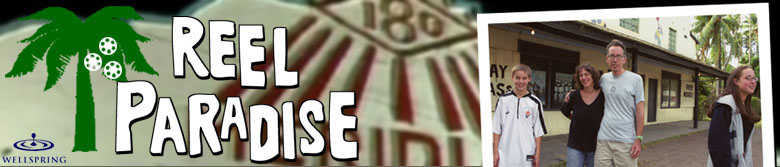
To see that, check out Reel Paradise, a movie about the saga of American film maker maker John Pierson who in 2002 relocated his family
to Taveuni for a year to show free movies at the venerable Meridian Cinema near Waiyevo.
Read More...
|

Interview with John and Janet Pierson - Reel Paradise
On the latest episode of DVD Talk Radio, DVD Talk Editor Geoffrey Kleinman speaks with John and Janet Pierson about the DVD release for Reel Paradise.
Read More...
|

No Family Is an Island
BY SPENCER PARSONS
The Piersons on 'Reel Paradise'
Read More...
|
|
Reel Paradise: Review
BY Marc Savlov
When it comes to mid-life crises, some guys buy Porsches, some nail hot blondes,
and some just muddle through. Freshly minted Austinite and famed producer's rep/author/gadabout John Pierson chose to relocate his entire family.
Read More...
|

'Reel Paradise': Moving Theater Experience in Fiji
by Alex Chadwick
American movie buff and independent filmmaker John Pierson moved his family to Fiji in 2002 in search of "the world's most remote theater."
Read More...
|

Reel Paradise: Review
By Roger Ebert
Steve James' new documentary, "Reel Paradise," is about a couple with similar idealism, who also move to a small town and buy the movie theater.
Read More...
|

Reel Paradise: Review
By Kevin Crust
MOVIE REVIEW: A family, a film house and Fiji.
Read More...
|
|
Taking popcorn fare to paradise
By Merrill Balassone
It's like moviegoing is new again when a producer shows free films in Fiji.
Read More...
|

How an American family moved to Fiji and brought Hollywood along for the ride
By Edward Guthmann
After 25 years of making top-notch indie films, John Pierson needed to escape. So off to Fiji he went, bringing
his family to begin a new life. He documented the experience in "Reel Paradise."
Read More...
|

Keeping It 'Reel' in Paradise
By ANDY KLEIN
In 2002, well known indie film figure John Pierson - producer's rep for She's Gotta Have It, Clerks, and Roger & Me, host of IFC's Split Screen series, and author of Spike, Mike, Slackers
& Dykes - picked up his family and moved to Fiji for a year to show free movies.
Read More...
|

LA Weekly: Film
By Scott Foundas
The final month of Pierson's quixotic quest is chronicled by documentary filmmaker Steve James in Reel Paradise and the result is an enormously warm, comic travelogue about how you can go to the ends of the earth and still not escape from temperamental
teenagers, absentee landlords and the universal language of moving pictures.
Read More...
|

Creating a Free Cinema Off Beaten Track in Fiji
By STEPHEN HOLDEN
Steve James's absorbing documentary follows a family to the rural Fijian island of Taveuni, where they showed free
movies in the world's most remote movie theater.
Read More...
|

'Paradise' found in Fiji
By LILY OEI
Indiewood came out in droves Monday to celebrate the Gotham preem of Wellspring's "Reel Paradise."
Read More...
|
|
A Cinema So Indie It's 5,000 Miles Away
By David Hochman
The Pierson's experiences running a cinema in Fiji are the subject of the documentary "Reel Paradise."
Read More...
|

On Screen and In a New City, Austin Embraces The Pierson Family
By Eugene Hernandez
These days, aside from traveling to a few film festivals to talk about Steve James' Miramax doc about their time in Fiji, "Reel Paradise,"
the Pierson's have become key figures within the Austin film scene.
Read More...
|
|
Variety - Reel Paradise
By Todd McCarthy
Indie film guru John Pierson goes native, sort of, in "Reel Paradise," an engaging docu about his year-long
stint showing free movies to the locals at what's purportedly
the world's most remote cinema, the 180 Meridian in Taveuni, Fiji.
Read More...
|
|
Sundance #3: Of heart and humor
By Roger Ebert
Another Sundance doc is also a wonderful portrait of an unexpected lifetime. Steve James, who directed
"Hoop Dreams," is here with "Reel Paradise," the story of a New Yorker named John Pierson, who distributed
and represented the films of Spike Lee, Kevin Smith and many other indie directors,
and hosted "Split Screen," an IFC program on independent films.
Read More...
|

Paradise Found
By Bill Chambers
Hoop-dream master Steve James on his latest film, REEL PARADISE
Read More...
|
Isle of Forgotten Fans
By John Pierson
I recently became the proud owner of the world's most remote movie theater. A year from now, you could be wearing a T-shirt that says, "I saw it at the 180 Meridian Cinema." At least that's how I see it.
Read More...
|
Fiji Favorites: Guys in Dresses
By Dave Kehr
The Piersons are back, and the New York independent film community is happy to see them home.
Read More...
|
 |


|

|

|
|
|