|

The Flipside of Fiji
For his third feature-length documentary, Hoop Dreams creator Steve James was more than happy to focus on the picture-imperfect aspects of the tropical isle.
By Brent Simon
Documentary filmmaker Steve James has always been fascinated by the friction of marginalized social classes, from 1994's award-winning Hoop Dreams - which in chronicling the yearnings of two inner-city prep basketball prospects helped kick off an American documentary renaissance - to 2003's piercing Stevie, which examines a troubled young man that James mentored a dozen years earlier through a Big Brothers-Big Sisters program, and grapples with the filmmaker's own feelings about Stevie's downward-spiraling life as much as his subject's existence.
So it's no surprise, then, that James' latest film - a sort of to-scale Burden of Dreams that charts the collision of two disparate cultures and centers around an obstinate, film-obsessed personality - follows what happens when noted indie film maven John Pierson (author of Spike, Mike, Slackers & Dykes and co-creator of IFC's Split Screen) takes his family to Taveuni, Fiji for a year to program free Hollywood movies at the world's most remote movie theater.
What is surprising is what follows, from jaw-dropping spats with a drunken landlord, a burglary (the family's second) and drunken no-show projectionists (do you sense a theme developing here?) to all-too-identifiable familial bickering and delinquency and a nasty, quite serious quarrel with the native Catholic church over Pierson's start time conflicting with evening mass.
Along the way, locals react alternately with peals of delighted laughter and contextual confusion to a roster of big studio fare that includes Bringing Down the House, X-2, Johnny English, Jackass, The Hot Chick, Chicago and Maid in Manhattan, along with a smattering of Hindi films and the occasional offbeat entry, like Rabbit-Proof Fence and old Three Stooges reels. Reel Paradise is a fascinatingly entertaining mash-up of two cultures Ñ broadly, the haves and the have-nots Ñ that asks probing, substantive questions about what the United States' role as the dominant exporter of pop culture means in the world at large.
While some of the themes in Reel Paradise were familiar to James, who was approached personally by Pierson about doing the film, the point of original focus was not. "These are very different subjects for me," allows James during a recent interview with FilmStew. "Upper-middle class, highly educated, white."
"I'd known John since Hoop Dreams," he continues. "He was someone who'd seen the film before it was done and was a real champion of it. So I stayed in touch with him over the years and had more of a phone friendship with him than anything else."
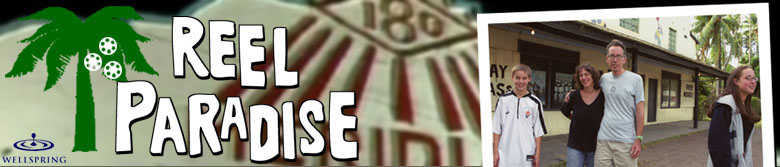
Pierson first came across the 180 Meridian Cinema, as it's known, for his television show, and when he saw the wild enthusiasm of the audience, he decided to move to Taveuni, one of the smallest and most impoverished of the over 320 Fijian Islands, to operate the cinema and show free movies. He also saw this unique, year-long adventure (ÔI'm the guy in Mosquito Coast,' he says in the film, Ôand this is my midlife crisis mission with my family') as a great opportunity to introduce his wife Janet, casually combative 13-year-old son Wyatt and spunky, standoffish 16-year-old daughter Georgia to a society and lifestyle far different from that of the New York suburbs.
That's all fine and dandy, but most of James' documentaries span years in their field of vision; for this one, he would only have the funding for one month, the final 30 days of the Pierson's adventure. Would it be enough to form a cohesive narrative?
"I'm always partial to verit; when something's unfolding and happening, that's when I'm most there," James admits. "I knew enough about what [Pierson] was up to that it sounded intriguing. But being there for only a month, I wasn't sure we could capture enough material to have real arcs."
"Going in, I thought there were two basic but very broad themes I would try to document," he continues. "One was to look at the heavy amount of current, Hollywood films he was showing there and gauge their affect on the local population, both the poorer native Fijians and the merchant class Indo-Fijians."
"The other part was that I had didn't really know his family. I had met his wife Janet briefly but had never set eyes on his kids, so I was very curious about the whole idea of an American family abroad in basically a Third World country. I had just come off of finishing a PBS miniseries called The New Americans, where we followed immigrants coming to America, so this was sort of going in reverse, and it was intriguing on that level too."
The arcs came together with surprising ease and clarity. A 10-night movie send-off series and the spat with the Catholic church showcased film's place in Fijian society, while Georgia's emergent rebelliousness and other minor familial discord provided an interesting contrast to the native Fijian characters in the movie.
Then there's Pierson himself, a true original whose missionary zeal ironically parallels the church's fervor. "What I knew about John going in from my previous relationship with him was that he's a very opinionated, irreverent, larger-than-life kind of guy," says James. "So I wasn't surprised at those qualities."
"But I was surprised to some degree at the passion he brought to what he was doing and of course how sometimes that passion got him into trouble," he reveals. "The qualities that make him so charismatic - that he shoots from the hip and that he's not politically correct, despite the fact that he's politically pretty liberal - all these things that I admire about him are the same things that get him in trouble, with the people in Fiji, the church and I think maybe sometimes even with his own family."
James has, throughout his career, seen the landscape of documentary filmmaking change. Heck, he's had a hand in shaping some of that change with Hoop Dreams - widely credited alongside Michael Moore's Roger & Me as breaking open mainstream interest in the non-fiction format, showing people that there was fascinating and inherent drama in everyday lives.
But James wasn't a movie buff growing up in Hampton, Virginia; in fact, he can only recall one theater in town. Rather, he was into sports, something not surprising when you consider both Hoop Dreams and the informal, based-on-fact feature trilogy that studs James filmography (the high school segregationist basketball flick Passing Glory, the boxing drama Joe and Max and Prefontaine, a biopic on the charismatic University of Oregon long-distance runner who died in a car crash at the age of 24). That's right, James is one of a select few documentary filmmakers to successfully cross over into feature films Ñ and back again. It's something he says he'd like to continue to do, even as he appreciates the newfound cachet of non-fiction.
"We're living in this golden age of documentaries, I think, and so you have to say that it's a great time," James says. "When we were making Hoop Dreams you had to find someone with a good camera who was willing to let you have it for nothing, or for very little money. If that person was a cameraman to boot, that was even better. And they'd have to be willing to work on it for nothing. And then you had to find a place to edit it. Nobody had this [equipment] at home. The means of production were largely unaffordable and grants were hard to get."
Still, it's not all roses now that movies like Bowling For Columbine, Fahrenheit 9/11 and March of the Penguins have opened eyes - and consumer wallets - to documentary filmmaking. "Partially because of the advances in technology that have contributed to making it possible, I don't think that the funding situation has improved immeasurably for people making documentaries and trying to make a living at it," James notes. "There's actually less foundation money out there than there used to be because many foundations that supported documentaries in the past don't do so anymore Ñ they view them as too expensive, and they don't get the bang for their buck."
With James and Reel Paradise, you certainly do, however, and one imagines that with his will, there will continue to be a way.
More Press...
|
 |

 |

I'm seated, with my mother, on a palace veranda, cooled by a breeze from the royal garden. Before us, on a dais, is an empty throne, its arms and legs embossed with polished brass, the back and seat covered in black-and-gold silk. In front of the steps to the dais, there are two columns of people, mostly men, facing one another, seated on carved wooden stools, the cloths they wear wrapped around their chests, leaving their shoulders bare.
Read More...
|

Then there's Hollywood's interpretation of the island...
To see that, check out Reel Paradise, a movie about the saga of American film maker maker John Pierson who in 2002 relocated his family
to Taveuni for a year to show free movies at the venerable Meridian Cinema near Waiyevo.
Read More...
|

Interview with John and Janet Pierson - Reel Paradise
On the latest episode of DVD Talk Radio, DVD Talk Editor Geoffrey Kleinman speaks with John and Janet Pierson about the DVD release for Reel Paradise.
Read More...
|

No Family Is an Island
BY SPENCER PARSONS
The Piersons on 'Reel Paradise'
Read More...
|
|
Reel Paradise: Review
BY Marc Savlov
When it comes to mid-life crises, some guys buy Porsches, some nail hot blondes,
and some just muddle through. Freshly minted Austinite and famed producer's rep/author/gadabout John Pierson chose to relocate his entire family.
Read More...
|

'Reel Paradise': Moving Theater Experience in Fiji
by Alex Chadwick
American movie buff and independent filmmaker John Pierson moved his family to Fiji in 2002 in search of "the world's most remote theater."
Read More...
|

Reel Paradise: Review
By Roger Ebert
Steve James' new documentary, "Reel Paradise," is about a couple with similar idealism, who also move to a small town and buy the movie theater.
Read More...
|

Reel Paradise: Review
By Kevin Crust
MOVIE REVIEW: A family, a film house and Fiji.
Read More...
|
|
Taking popcorn fare to paradise
By Merrill Balassone
It's like moviegoing is new again when a producer shows free films in Fiji.
Read More...
|

How an American family moved to Fiji and brought Hollywood along for the ride
By Edward Guthmann
After 25 years of making top-notch indie films, John Pierson needed to escape. So off to Fiji he went, bringing
his family to begin a new life. He documented the experience in "Reel Paradise."
Read More...
|

Keeping It 'Reel' in Paradise
By ANDY KLEIN
In 2002, well known indie film figure John Pierson - producer's rep for She's Gotta Have It, Clerks, and Roger & Me, host of IFC's Split Screen series, and author of Spike, Mike, Slackers
& Dykes - picked up his family and moved to Fiji for a year to show free movies.
Read More...
|

LA Weekly: Film
By Scott Foundas
The final month of Pierson's quixotic quest is chronicled by documentary filmmaker Steve James in Reel Paradise and the result is an enormously warm, comic travelogue about how you can go to the ends of the earth and still not escape from temperamental
teenagers, absentee landlords and the universal language of moving pictures.
Read More...
|

Creating a Free Cinema Off Beaten Track in Fiji
By STEPHEN HOLDEN
Steve James's absorbing documentary follows a family to the rural Fijian island of Taveuni, where they showed free
movies in the world's most remote movie theater.
Read More...
|

'Paradise' found in Fiji
By LILY OEI
Indiewood came out in droves Monday to celebrate the Gotham preem of Wellspring's "Reel Paradise."
Read More...
|
|
A Cinema So Indie It's 5,000 Miles Away
By David Hochman
The Pierson's experiences running a cinema in Fiji are the subject of the documentary "Reel Paradise."
Read More...
|

On Screen and In a New City, Austin Embraces The Pierson Family
By Eugene Hernandez
These days, aside from traveling to a few film festivals to talk about Steve James' Miramax doc about their time in Fiji, "Reel Paradise,"
the Pierson's have become key figures within the Austin film scene.
Read More...
|
|
Variety - Reel Paradise
By Todd McCarthy
Indie film guru John Pierson goes native, sort of, in "Reel Paradise," an engaging docu about his year-long
stint showing free movies to the locals at what's purportedly
the world's most remote cinema, the 180 Meridian in Taveuni, Fiji.
Read More...
|
|
Sundance #3: Of heart and humor
By Roger Ebert
Another Sundance doc is also a wonderful portrait of an unexpected lifetime. Steve James, who directed
"Hoop Dreams," is here with "Reel Paradise," the story of a New Yorker named John Pierson, who distributed
and represented the films of Spike Lee, Kevin Smith and many other indie directors,
and hosted "Split Screen," an IFC program on independent films.
Read More...
|

Paradise Found
By Bill Chambers
Hoop-dream master Steve James on his latest film, REEL PARADISE
Read More...
|
Isle of Forgotten Fans
By John Pierson
I recently became the proud owner of the world's most remote movie theater. A year from now, you could be wearing a T-shirt that says, "I saw it at the 180 Meridian Cinema." At least that's how I see it.
Read More...
|
Fiji Favorites: Guys in Dresses
By Dave Kehr
The Piersons are back, and the New York independent film community is happy to see them home.
Read More...
|
 |


|

|

|
|
|