|

Reel Paradise: Review
I know a couple named Jon and Jennifer Vickers, who moved to Three Oaks, Mich., (population 1,829) and bought the local movie theater. It's 30 miles from the closest multiplex. They show first-run art films, and after eight years are a solid success. "The audience isn't just the Chicago weekend people," my friend Mary Jo Broderick tells me. She goes every week. "I see the same people I see in the supermarket in February." The Vickers' theater doesn't show only "March of the Penguins" but Herzog, Wong Kar Wai, Bergman, Jarmusch. Every summer, they have a silent film festival.
Steve James' new documentary, "Reel Paradise," is about a couple with similar idealism, who also move to a small town and buy the movie theater. Their theater is the 180 Meridian, on Taveuni, one of the Fiji Islands. They aren't trying to bring art cinema to Fiji; they're trying to bring the movies, period. The audience favorite is "Jackass," a film so popular it is banned by the local authorities.
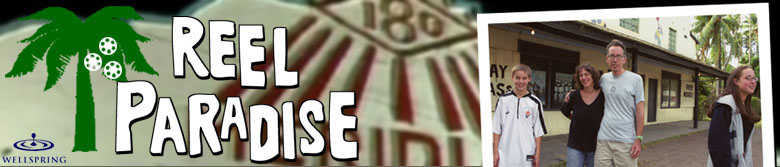
The man behind this idea is John Pierson, a producer's rep well-known in indie film circles and crucial to the early success of such directors as Spike Lee (he invested in "She's Gotta Have It") and Michael Moore ("Roger & Me"). I've run into him over the years at festivals like Sundance. He tired of the indie-circuit routine and convinced his wife, Janet, and their children, Georgia, 16, and Wyatt, 13, to join him for a year running a movie theater in Fiji. They do not entirely share his enthusiasm.
James, who made "Hoop Dreams," arrives in time to chronicle the final month of this experiment. What Pierson proved for sure is that if you show movies for free, you will get an audience. He also proved that a certain kind of great film, such as Buster Keaton's "Steamboat Bill, Jr.," will draw a crowd. It's always claimed that silent comedy is universal in its appeal; here's your proof.
Pierson wanted to show all kinds of movies. He has a hit with "The Hot Chick." He doesn't do so well with more ambitious films. By the time James arrives with his camera, Pierson has contracted dengue fever and his son has taken over the day-to-day operations at the 180 Meridian. He may be the son of a legendary art film supporter, but Wyatt keeps his eye firmly on the box office: "If you show 'Apocalypse Now' twice," he tells his dad, "I guarantee no one will come the second night." If a fortune is to be made by the Pierson family in the movie business, it may be made by Wyatt.
Fiji seems like a paradise from a distance, but when you live there it turns into a real place with real problems. There is the heat, the humidity, the lack of a power grid (the theater has its own generator). The projectionist tends to get drunk. There is the reality that Georgia is a teenager and interested in boys and, like all teenagers, wants to stay out past her curfew.
There are also two burglaries of the Piersons' home. Suspicion for this crime falls upon people the Piersons like and trust. Considering that the island has only one road, it should not be hard to find the stolen computer, but it is. I am reminded of my visit to Bora Bora when "Hurricane" was being shot there. The movie publicist's Jeep was stolen. The sheriff advised him to stand outside and wait until it came around; the island had one road, which circled the island.
The priests at the Catholic mission disapprove of many of Pierson's movies (especially "Jackass") and think that by showing them for free, he is undercutting the work ethic. The local teenagers hang out together and sometimes seem up to no good, but that is the nature of teenagers, and the dangers on Taveuni are mild compared to those in New York.
When the experiment ends and the Piersons return to America, the theater closes again. It is hard to say what they accomplished. It's nice to think that if you show people movies, especially good movies, that will somehow change or improve their lives. But movies out of context are a curiosity and may play in unexpected ways. The politically correct might question a Three Stooges movie involving a South Seas cannibal's boiling pot, but the audience explodes with such uncontrolled laughter that you can forget about hearing the dialogue.
The Piersons went, they showed movies, they returned. Taveuni is more or less the same. But by living and coping together for a year, the family is probably stronger and richer: Years from now, Georgia and Wyatt are going to be telling people about how their crazy parents opened a movie theater in Fiji, and in their voices you will hear that although they had their doubts at the time, they now think they were lucky to have such parents. Sometimes it's not whether you succeed, but whether you try.
More Press...
|
 |

 |

I'm seated, with my mother, on a palace veranda, cooled by a breeze from the royal garden. Before us, on a dais, is an empty throne, its arms and legs embossed with polished brass, the back and seat covered in black-and-gold silk. In front of the steps to the dais, there are two columns of people, mostly men, facing one another, seated on carved wooden stools, the cloths they wear wrapped around their chests, leaving their shoulders bare.
Read More...
|

Then there's Hollywood's interpretation of the island...
To see that, check out Reel Paradise, a movie about the saga of American film maker maker John Pierson who in 2002 relocated his family
to Taveuni for a year to show free movies at the venerable Meridian Cinema near Waiyevo.
Read More...
|

Interview with John and Janet Pierson - Reel Paradise
On the latest episode of DVD Talk Radio, DVD Talk Editor Geoffrey Kleinman speaks with John and Janet Pierson about the DVD release for Reel Paradise.
Read More...
|

No Family Is an Island
BY SPENCER PARSONS
The Piersons on 'Reel Paradise'
Read More...
|
|
Reel Paradise: Review
BY Marc Savlov
When it comes to mid-life crises, some guys buy Porsches, some nail hot blondes,
and some just muddle through. Freshly minted Austinite and famed producer's rep/author/gadabout John Pierson chose to relocate his entire family.
Read More...
|

'Reel Paradise': Moving Theater Experience in Fiji
by Alex Chadwick
American movie buff and independent filmmaker John Pierson moved his family to Fiji in 2002 in search of "the world's most remote theater."
Read More...
|

Reel Paradise: Review
By Roger Ebert
Steve James' new documentary, "Reel Paradise," is about a couple with similar idealism, who also move to a small town and buy the movie theater.
Read More...
|

Reel Paradise: Review
By Kevin Crust
MOVIE REVIEW: A family, a film house and Fiji.
Read More...
|
|
Taking popcorn fare to paradise
By Merrill Balassone
It's like moviegoing is new again when a producer shows free films in Fiji.
Read More...
|

How an American family moved to Fiji and brought Hollywood along for the ride
By Edward Guthmann
After 25 years of making top-notch indie films, John Pierson needed to escape. So off to Fiji he went, bringing
his family to begin a new life. He documented the experience in "Reel Paradise."
Read More...
|

Keeping It 'Reel' in Paradise
By ANDY KLEIN
In 2002, well known indie film figure John Pierson - producer's rep for She's Gotta Have It, Clerks, and Roger & Me, host of IFC's Split Screen series, and author of Spike, Mike, Slackers
& Dykes - picked up his family and moved to Fiji for a year to show free movies.
Read More...
|

LA Weekly: Film
By Scott Foundas
The final month of Pierson's quixotic quest is chronicled by documentary filmmaker Steve James in Reel Paradise and the result is an enormously warm, comic travelogue about how you can go to the ends of the earth and still not escape from temperamental
teenagers, absentee landlords and the universal language of moving pictures.
Read More...
|

Creating a Free Cinema Off Beaten Track in Fiji
By STEPHEN HOLDEN
Steve James's absorbing documentary follows a family to the rural Fijian island of Taveuni, where they showed free
movies in the world's most remote movie theater.
Read More...
|

'Paradise' found in Fiji
By LILY OEI
Indiewood came out in droves Monday to celebrate the Gotham preem of Wellspring's "Reel Paradise."
Read More...
|
|
A Cinema So Indie It's 5,000 Miles Away
By David Hochman
The Pierson's experiences running a cinema in Fiji are the subject of the documentary "Reel Paradise."
Read More...
|

On Screen and In a New City, Austin Embraces The Pierson Family
By Eugene Hernandez
These days, aside from traveling to a few film festivals to talk about Steve James' Miramax doc about their time in Fiji, "Reel Paradise,"
the Pierson's have become key figures within the Austin film scene.
Read More...
|
|
Variety - Reel Paradise
By Todd McCarthy
Indie film guru John Pierson goes native, sort of, in "Reel Paradise," an engaging docu about his year-long
stint showing free movies to the locals at what's purportedly
the world's most remote cinema, the 180 Meridian in Taveuni, Fiji.
Read More...
|
|
Sundance #3: Of heart and humor
By Roger Ebert
Another Sundance doc is also a wonderful portrait of an unexpected lifetime. Steve James, who directed
"Hoop Dreams," is here with "Reel Paradise," the story of a New Yorker named John Pierson, who distributed
and represented the films of Spike Lee, Kevin Smith and many other indie directors,
and hosted "Split Screen," an IFC program on independent films.
Read More...
|

Paradise Found
By Bill Chambers
Hoop-dream master Steve James on his latest film, REEL PARADISE
Read More...
|
Isle of Forgotten Fans
By John Pierson
I recently became the proud owner of the world's most remote movie theater. A year from now, you could be wearing a T-shirt that says, "I saw it at the 180 Meridian Cinema." At least that's how I see it.
Read More...
|
Fiji Favorites: Guys in Dresses
By Dave Kehr
The Piersons are back, and the New York independent film community is happy to see them home.
Read More...
|
 |


|

|

|
|
|