|

Sundance #3: Of heart and humor
BY ROGER EBERT / January 25, 2005
PARK CITY, Utah -- I knew you needed leather balls to play rugby, but I didn't know you could also use steel ball bearings. "Murderball," probably the most talked-about documentary at Sundance this year, is about the extreme sport of wheelchair rugby, played in reinforced and armored chairs by quadriplegics with various degrees of disability. It is a full-contact sport.
The film follows the fortunes of Team USA, undefeated for 11 years in the annual tournaments, and one of its stars, Mark Zupan, who intimidates opponents with a fierce goatee and bold tattoos. Another player, Joe Soares, was all-American for years, but has been dropped from the team. In revenge, he becomes coach of the Canadian team, setting up fierce duels at a tournament and also at the 2004 Athens Paralympics.
The movie works first of all as an astonishing sports documentary. The rules are simple: When you have the ball, you have to dribble or pass within 10 seconds. Cross the goal line with the ball, and you score. Degrees of disability are rated from 0.5 to 3.0, and a team is allowed to field players totaling eight points. One of the best American players has no lower arms or legs.
The players are strapped into their customized chairs, and a good thing, too, because one of the ways you play the game is to crash into an opponent and try to knock his chair over. That happens a lot. Before their injuries, these guys were jocks. They still are.
But the heart of "Murderball," directed by Dana Adam Shapiro and Henry Alex Rubin and produced by Jeff Mandel, is the story of overcoming injuries and despair, and learning through rehabilitation and training not only to function in the everyday world, but to become Olympians. The movie is very frank about details of quadriplegia, including questions about sexuality (yes, many quads can). Most people think all quads are paralyzed from the neck down, like Christopher Reeve, but we find there are degrees of paralysis and many retain various degrees of control of their limbs.
They talk about how people are awkward around them, and don't know what to say, and Zupan says: "Hey, I'm shorter than you because I'm in this chair. That's about it." During a school visit, an 8-year-old displays the openness of children when he asks the player without forearms: "How do you eat your pizza?" He finds out. Also how the player cooks, drives and plays quad rugby.
There is controversy here this year about two recent films in which paralyzed characters decide that they want to die. Listen to Mark Zupan, who is attending Sundance with his best buddy, Christopher Igor. In high school, it was Chris who crashed his pickup, not realizing Mark was asleep in the truck bed. Mark was thrown into a canal, where he awaited rescue for 13 hours.
They went through a period of blame and guilt, they said, before finally accepting that it was an accident. They're best friends again. An audience member asked, "If you could, would you turn back the clock on that day?" Zupan, whose full-time job is as a civil engineer, answered slowly and seriously: "No, I don't think so. My injury has led me to opportunities and experiences and friendships I would never have had before. And it has taught me about myself." A pause. "In some ways, it's the best thing that ever happened to me.
Another Sundance doc is also a wonderful portrait of an unexpected lifetime. Steve James, who directed "Hoop Dreams,"
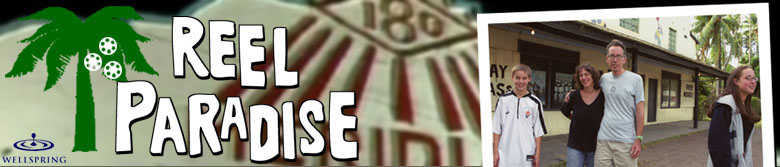
is here with "Reel Paradise," the story of a New Yorker named John Pierson, who distributed and represented the films of Spike Lee, Kevin Smith and many other indie directors, and hosted "Split Screen," an IFC program on independent films.
He grew tired of doing the same job day after day, he said, and decided to move with his wife, Georgia, teenage daughter Janet and middle-school son Wyatt to -- well, to Taveuni, one of the smaller and more obscure of the Fiji Islands. There they would reopen the local movie theater and show movies -- mostly free -- for a year.
Steve James joined the Pierson family for the last month of their year to shoot this film. You might wonder if there is much of a film to shoot: Movie nut goes tropical, shows Buster Keaton, "Matrix" and "Jackass" to cheering local audiences. But James has a knack, a gift or a curse of turning up when dramatic things are happening. The closing scenes of "Hoop Dreams" outrival fiction, for example.
Here, what happens is such intriguing human drama that we realize: This is what reality TV could be like if it had a brain and a soul. Pierson's experiment in Fiji is a great success, despite travails with unpredictable projectionists. The theater is jammed with audiences who scream with delight more or less nonstop through everything, which is why Buster Keaton is so popular: With a silent film, you don't need to hear the dialogue. He also shows "Apocalypse Now," over the objections of Wyatt, an uncommonly smart and realistic kid who predicts no one will come, and observes that "most indie films are boring."
Meanwhile, Janet has become best friends with Miriama, a girl her age, and goes through a period of wanting to stay out later than her mother thinks is wise. It's the usual teenage rebellion stuff, made simpler because her Fijian friends are good kids. But then there are two thefts, including John and Georgia's laptop computers, and suspicion descends -- not on Miriama, but in general. It feels like betrayal.
Still, the family loves their decision to spend a year on the other side of the world, and Wyatt observes that in New York, he might have five kids in his house in a week, but in Fiji, he never had less than five friends in the house at any given time. The movie is about families, cultural differences, ideas of raising children -- and about movies. If I had seen "Jackass" in John Pierson's theater with those 300 uproariously happy kids, I might have liked it. I certainly would have understood it better.
More Press...
|
 |

 |

I'm seated, with my mother, on a palace veranda, cooled by a breeze from the royal garden. Before us, on a dais, is an empty throne, its arms and legs embossed with polished brass, the back and seat covered in black-and-gold silk. In front of the steps to the dais, there are two columns of people, mostly men, facing one another, seated on carved wooden stools, the cloths they wear wrapped around their chests, leaving their shoulders bare.
Read More...
|

Then there's Hollywood's interpretation of the island...
To see that, check out Reel Paradise, a movie about the saga of American film maker maker John Pierson who in 2002 relocated his family
to Taveuni for a year to show free movies at the venerable Meridian Cinema near Waiyevo.
Read More...
|

Interview with John and Janet Pierson - Reel Paradise
On the latest episode of DVD Talk Radio, DVD Talk Editor Geoffrey Kleinman speaks with John and Janet Pierson about the DVD release for Reel Paradise.
Read More...
|

No Family Is an Island
BY SPENCER PARSONS
The Piersons on 'Reel Paradise'
Read More...
|
|
Reel Paradise: Review
BY Marc Savlov
When it comes to mid-life crises, some guys buy Porsches, some nail hot blondes,
and some just muddle through. Freshly minted Austinite and famed producer's rep/author/gadabout John Pierson chose to relocate his entire family.
Read More...
|

'Reel Paradise': Moving Theater Experience in Fiji
by Alex Chadwick
American movie buff and independent filmmaker John Pierson moved his family to Fiji in 2002 in search of "the world's most remote theater."
Read More...
|

Reel Paradise: Review
By Roger Ebert
Steve James' new documentary, "Reel Paradise," is about a couple with similar idealism, who also move to a small town and buy the movie theater.
Read More...
|

Reel Paradise: Review
By Kevin Crust
MOVIE REVIEW: A family, a film house and Fiji.
Read More...
|
|
Taking popcorn fare to paradise
By Merrill Balassone
It's like moviegoing is new again when a producer shows free films in Fiji.
Read More...
|

How an American family moved to Fiji and brought Hollywood along for the ride
By Edward Guthmann
After 25 years of making top-notch indie films, John Pierson needed to escape. So off to Fiji he went, bringing
his family to begin a new life. He documented the experience in "Reel Paradise."
Read More...
|

Keeping It 'Reel' in Paradise
By ANDY KLEIN
In 2002, well known indie film figure John Pierson - producer's rep for She's Gotta Have It, Clerks, and Roger & Me, host of IFC's Split Screen series, and author of Spike, Mike, Slackers
& Dykes - picked up his family and moved to Fiji for a year to show free movies.
Read More...
|

LA Weekly: Film
By Scott Foundas
The final month of Pierson's quixotic quest is chronicled by documentary filmmaker Steve James in Reel Paradise and the result is an enormously warm, comic travelogue about how you can go to the ends of the earth and still not escape from temperamental
teenagers, absentee landlords and the universal language of moving pictures.
Read More...
|

Creating a Free Cinema Off Beaten Track in Fiji
By STEPHEN HOLDEN
Steve James's absorbing documentary follows a family to the rural Fijian island of Taveuni, where they showed free
movies in the world's most remote movie theater.
Read More...
|

'Paradise' found in Fiji
By LILY OEI
Indiewood came out in droves Monday to celebrate the Gotham preem of Wellspring's "Reel Paradise."
Read More...
|
|
A Cinema So Indie It's 5,000 Miles Away
By David Hochman
The Pierson's experiences running a cinema in Fiji are the subject of the documentary "Reel Paradise."
Read More...
|

On Screen and In a New City, Austin Embraces The Pierson Family
By Eugene Hernandez
These days, aside from traveling to a few film festivals to talk about Steve James' Miramax doc about their time in Fiji, "Reel Paradise,"
the Pierson's have become key figures within the Austin film scene.
Read More...
|
|
Variety - Reel Paradise
By Todd McCarthy
Indie film guru John Pierson goes native, sort of, in "Reel Paradise," an engaging docu about his year-long
stint showing free movies to the locals at what's purportedly
the world's most remote cinema, the 180 Meridian in Taveuni, Fiji.
Read More...
|
|
Sundance #3: Of heart and humor
By Roger Ebert
Another Sundance doc is also a wonderful portrait of an unexpected lifetime. Steve James, who directed
"Hoop Dreams," is here with "Reel Paradise," the story of a New Yorker named John Pierson, who distributed
and represented the films of Spike Lee, Kevin Smith and many other indie directors,
and hosted "Split Screen," an IFC program on independent films.
Read More...
|

Paradise Found
By Bill Chambers
Hoop-dream master Steve James on his latest film, REEL PARADISE
Read More...
|
Isle of Forgotten Fans
By John Pierson
I recently became the proud owner of the world's most remote movie theater. A year from now, you could be wearing a T-shirt that says, "I saw it at the 180 Meridian Cinema." At least that's how I see it.
Read More...
|
Fiji Favorites: Guys in Dresses
By Dave Kehr
The Piersons are back, and the New York independent film community is happy to see them home.
Read More...
|
 |


|

|

|
|
|