|

Keeping It 'Reel' in Paradise
New documentary shows an American family learning to live on island time
By ANDY KLEIN
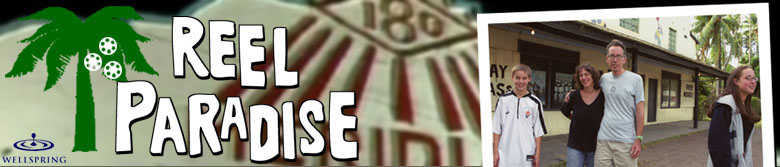
In 2002, well known indie film figure John Pierson - producer's rep for She's Gotta Have It, Clerks, and Roger & Me, host of IFC's Split Screen series, and author of Spike, Mike, Slackers & Dykes - picked up his family and moved to Fiji for a year to show free movies. A theater called the 180 Meridian Cinema had been inexplicably built on Taveuni, an island 25 miles by 8 miles, with roughly 10,000 inhabitants and no public electricity. As Pierson tells me in an interview, "The guy who built this theater was the Fitzcarraldo of Fiji, as far as I'm concerned, because there was no logical reason to build a movie theater there."
Toward the end of their stay, Pierson invited Steve James - the highly acclaimed director of Hoop Dreams and Stevie - to come over for a month and shoot a documentary ... "to have a record of what it was like in that movie theater," as Pierson says. Reel Paradise, however, is a good deal more than that - a look at contemporary Americans (or, at least, the Piersons) adapting to a third-world environment.
It is clear early in the film that the two kids - 13-year-old Wyatt and 16-year-old Georgia - integrate themselves far more easily than the adults. "I had done a series of public TV [The New Americans]," James tells me in a separate interview, "where we had followed immigrants coming into America, and it's the kids who immerse themselves more easily than adults ... . This was kind of the reverse, but that still held true."
Perhaps the most difficult part was the original goal. "I knew the range of films that John was showing," James says. That mix included
Jackie Chan and Bollywood, along with predominantly commercial American releases - from Apocalypse Now Redux to The Matrix to Jackass.
"I didn't want to give short shrift to the theater and ... the Fijians' experience of it ... . But attempts to get people to articulate
what those movies meant to them were quite fruitless. It wasn't much different than going to a multiplex and asking people on the way out,
'What does the movie mean to you? How does that movie impact your life?'"
Besides, events outside the theater experience intruded. Pierson tells me, "Steve arrived on a Saturday, then, all in the next six days, the projectionist stopped showing up for work, our house was robbed, Georgia ran away from home - of course, everybody knew where she was but us - our landlord [got into a fight] with Gopal [the cook's husband], and I got dengue fever."
The robbery occurred two days after the filmmakers arrived. I jokingly ask James if he arranged it just to goose things up. "No. I wish I was that smart," he says. "That's what they do in reality TV. It's ridiculous." But he managed to catch some of the aftermath. "We had a long day of filming, and we went back to the hotel. We were having dinner when I got a call in the hotel restaurant from Janet, saying they were robbed. It was a comical adventure, getting out to their place, because our driver had dropped us off and gone home, and the buses had stopped running."
Despite the delay in getting there, emotions were still pitched when they arrived. When the landlord shows up, he's more interested in collecting reimbursement for a bill than he is in commiserating, which understandably infuriates John. It's one of the scenes that has led some people to react negatively to him. He's the only one of the family who ever comes across badly.
"Some people come away from this film and don't like John," James says. "He can be blunt and tough. One of the things I like about him is the thing that gets him in trouble: As Wyatt says, ÔHe is who he is, wherever he is.' In all my films, I try to make the characters sympathetic without whitewashing them. I want people to see them as three-dimensional, but I don't want people to sit in easy judgment on them."
In person, Pierson comes across with an unbridled enthusiasm that some people might find obnoxious. (Think Quentin Tarantino.) We spend the first 10 minutes of the interview gabbing about Once Upon a Time in the West, Repo Man, the Austin-based Rolling Road Show, Zatoichi, the excellence of Warner Home Video, and Bollywood (and later get derailed over Memento, Primer, The Accidental Spy, and Murderball).
It makes getting down to business a little tough, but I thoroughly enjoy it and am as much of the problem as he is. But the issue of how he's portrayed in the film - particularly given that he and Janet are the producers - has to be broached. He gives me an opening when he's talking about Janet. "She comes across as a really solid, admirable character ... unlike some of us ... ."
"You come across ... " I search for the right word and fail to find it, finally settling on "difficult." (I later realize that the word I wanted was "impatient.")
I can tell Pierson is not thrilled by that. "By the end of the year, it was really a rough time for me," he says. "I was kinda at the end of my patience. After a year and a half of free movies, the audience was getting jaded. Their excitement was gone: Ho hum.
"You've got that going on, and then I got dengue," he continues. "For 10 days, I was in total and complete misery. If it wasn't for the movie, I might have simply stayed in bed ... . I did at one point get really upset with the situation, and I actually threw a chair at Steve ... . Well, not directly at him. Instead of it being a slice of life, it was a slice of life under stress."
It's not common that the subjects of a legitimate documentary are also the producers. I ask what the arrangement was. "Steve had to have carte blanche, so it would be lock, stock, and barrel his film," says Pierson.
James says, "John wanted to see it relatively early. But I kept saying no. When the family finally saw it, there were things about it they liked, and there were things about it that they very much did not like." He feels that the ensuing discussions about the film eventually made it better and fairer. "In the end, they're not completely happy with it. I'm not completely happy with it, but I'm never completely happy with a film. And we came through it and we're, like, friends."
Pierson is upset over Entertainment Weekly referring to the film as a "vanity production." Says Pierson, "If you could watch this film, with its - let's say - complicated portrayal of me, and call it a vanity production, you'd be nuts."
I wonder aloud whether that may have induced James to bend over backward to show Pierson's worse traits. "I think it was crucial for Steve that nobody should be able to say that about the film," Pierson says. "So, yes, he may have been making it all hang out about me to make sure that no one could call it that. So it ends up a lose-lose situation: He's getting accused of doing a vanity production, and I'm getting accused of being an asshole."
Reel Paradise. Directed and edited by Steve James. Cinematographer, P.H. O'Brien. With John Pierson, Janet Pierson, Georgia Pierson, and Wyatt Pierson. Opens Fri. at the Nuart.
More Press...
|
 |

 |

I'm seated, with my mother, on a palace veranda, cooled by a breeze from the royal garden. Before us, on a dais, is an empty throne, its arms and legs embossed with polished brass, the back and seat covered in black-and-gold silk. In front of the steps to the dais, there are two columns of people, mostly men, facing one another, seated on carved wooden stools, the cloths they wear wrapped around their chests, leaving their shoulders bare.
Read More...
|

Then there's Hollywood's interpretation of the island...
To see that, check out Reel Paradise, a movie about the saga of American film maker maker John Pierson who in 2002 relocated his family
to Taveuni for a year to show free movies at the venerable Meridian Cinema near Waiyevo.
Read More...
|

Interview with John and Janet Pierson - Reel Paradise
On the latest episode of DVD Talk Radio, DVD Talk Editor Geoffrey Kleinman speaks with John and Janet Pierson about the DVD release for Reel Paradise.
Read More...
|

No Family Is an Island
BY SPENCER PARSONS
The Piersons on 'Reel Paradise'
Read More...
|
|
Reel Paradise: Review
BY Marc Savlov
When it comes to mid-life crises, some guys buy Porsches, some nail hot blondes,
and some just muddle through. Freshly minted Austinite and famed producer's rep/author/gadabout John Pierson chose to relocate his entire family.
Read More...
|

'Reel Paradise': Moving Theater Experience in Fiji
by Alex Chadwick
American movie buff and independent filmmaker John Pierson moved his family to Fiji in 2002 in search of "the world's most remote theater."
Read More...
|

Reel Paradise: Review
By Roger Ebert
Steve James' new documentary, "Reel Paradise," is about a couple with similar idealism, who also move to a small town and buy the movie theater.
Read More...
|

Reel Paradise: Review
By Kevin Crust
MOVIE REVIEW: A family, a film house and Fiji.
Read More...
|
|
Taking popcorn fare to paradise
By Merrill Balassone
It's like moviegoing is new again when a producer shows free films in Fiji.
Read More...
|

How an American family moved to Fiji and brought Hollywood along for the ride
By Edward Guthmann
After 25 years of making top-notch indie films, John Pierson needed to escape. So off to Fiji he went, bringing
his family to begin a new life. He documented the experience in "Reel Paradise."
Read More...
|

Keeping It 'Reel' in Paradise
By ANDY KLEIN
In 2002, well known indie film figure John Pierson - producer's rep for She's Gotta Have It, Clerks, and Roger & Me, host of IFC's Split Screen series, and author of Spike, Mike, Slackers
& Dykes - picked up his family and moved to Fiji for a year to show free movies.
Read More...
|

LA Weekly: Film
By Scott Foundas
The final month of Pierson's quixotic quest is chronicled by documentary filmmaker Steve James in Reel Paradise and the result is an enormously warm, comic travelogue about how you can go to the ends of the earth and still not escape from temperamental
teenagers, absentee landlords and the universal language of moving pictures.
Read More...
|

Creating a Free Cinema Off Beaten Track in Fiji
By STEPHEN HOLDEN
Steve James's absorbing documentary follows a family to the rural Fijian island of Taveuni, where they showed free
movies in the world's most remote movie theater.
Read More...
|

'Paradise' found in Fiji
By LILY OEI
Indiewood came out in droves Monday to celebrate the Gotham preem of Wellspring's "Reel Paradise."
Read More...
|
|
A Cinema So Indie It's 5,000 Miles Away
By David Hochman
The Pierson's experiences running a cinema in Fiji are the subject of the documentary "Reel Paradise."
Read More...
|

On Screen and In a New City, Austin Embraces The Pierson Family
By Eugene Hernandez
These days, aside from traveling to a few film festivals to talk about Steve James' Miramax doc about their time in Fiji, "Reel Paradise,"
the Pierson's have become key figures within the Austin film scene.
Read More...
|
|
Variety - Reel Paradise
By Todd McCarthy
Indie film guru John Pierson goes native, sort of, in "Reel Paradise," an engaging docu about his year-long
stint showing free movies to the locals at what's purportedly
the world's most remote cinema, the 180 Meridian in Taveuni, Fiji.
Read More...
|
|
Sundance #3: Of heart and humor
By Roger Ebert
Another Sundance doc is also a wonderful portrait of an unexpected lifetime. Steve James, who directed
"Hoop Dreams," is here with "Reel Paradise," the story of a New Yorker named John Pierson, who distributed
and represented the films of Spike Lee, Kevin Smith and many other indie directors,
and hosted "Split Screen," an IFC program on independent films.
Read More...
|

Paradise Found
By Bill Chambers
Hoop-dream master Steve James on his latest film, REEL PARADISE
Read More...
|
Isle of Forgotten Fans
By John Pierson
I recently became the proud owner of the world's most remote movie theater. A year from now, you could be wearing a T-shirt that says, "I saw it at the 180 Meridian Cinema." At least that's how I see it.
Read More...
|
Fiji Favorites: Guys in Dresses
By Dave Kehr
The Piersons are back, and the New York independent film community is happy to see them home.
Read More...
|
 |


|

|

|
|
|